Site Preparation

Delivery Access Requirements

Road, driveway, and crane access — and what happens when access is difficult.

Reading time

9 min read

Last reviewed

August 2026

Applies to

VIC · NSW · QLD · SA · TAS · WA · NT

Covers

Road access · Height clearance · Crane setup · Driveway load · Powerlines

Why access is the forgotten risk

An expandable cottage is a large, heavy load. It arrives on a truck and is lifted into place by crane. If the route to your property, your driveway, or the site itself can't accommodate the truck and crane, delivery becomes more complex and expensive — or, in rare cases, impossible without alternative arrangements. An access assessment early in the process identifies problems while there's time to solve them, rather than discovering them on delivery day.

Road restrictions: width, height, weight

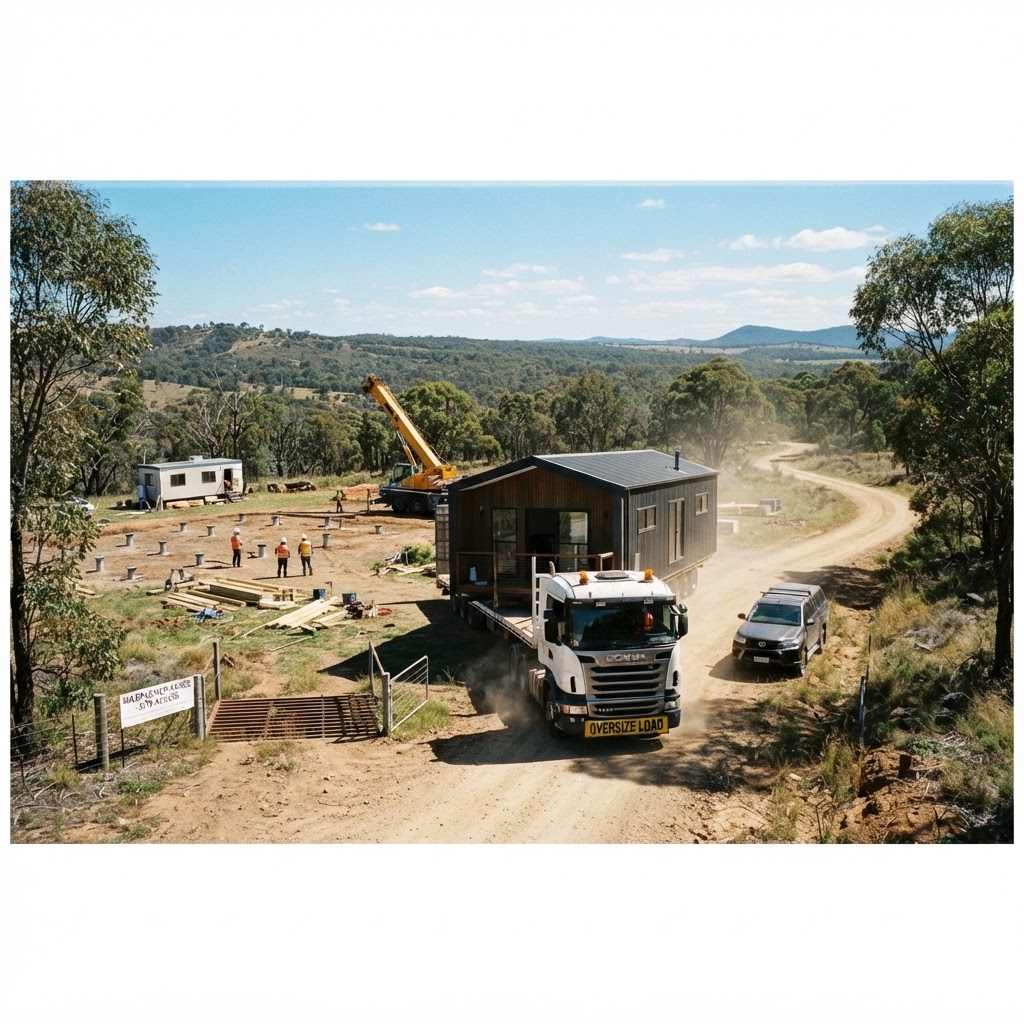
The delivery route must be passable for a large truck: adequate width (a standard cottage transport needs 3–4 metres plus clearance), adequate height clearance (overhead powerlines, branches, signs and bridges), adequate load-bearing capacity (some rural roads and bridges have weight limits), and navigable corners. Narrow rural lanes, low bridges, and tight roundabouts can all block a route. The transport company checks the route, but you can flag obvious issues early — a quick drive of the route with a tape measure can save a costly discovery later.

Your driveway: load and width

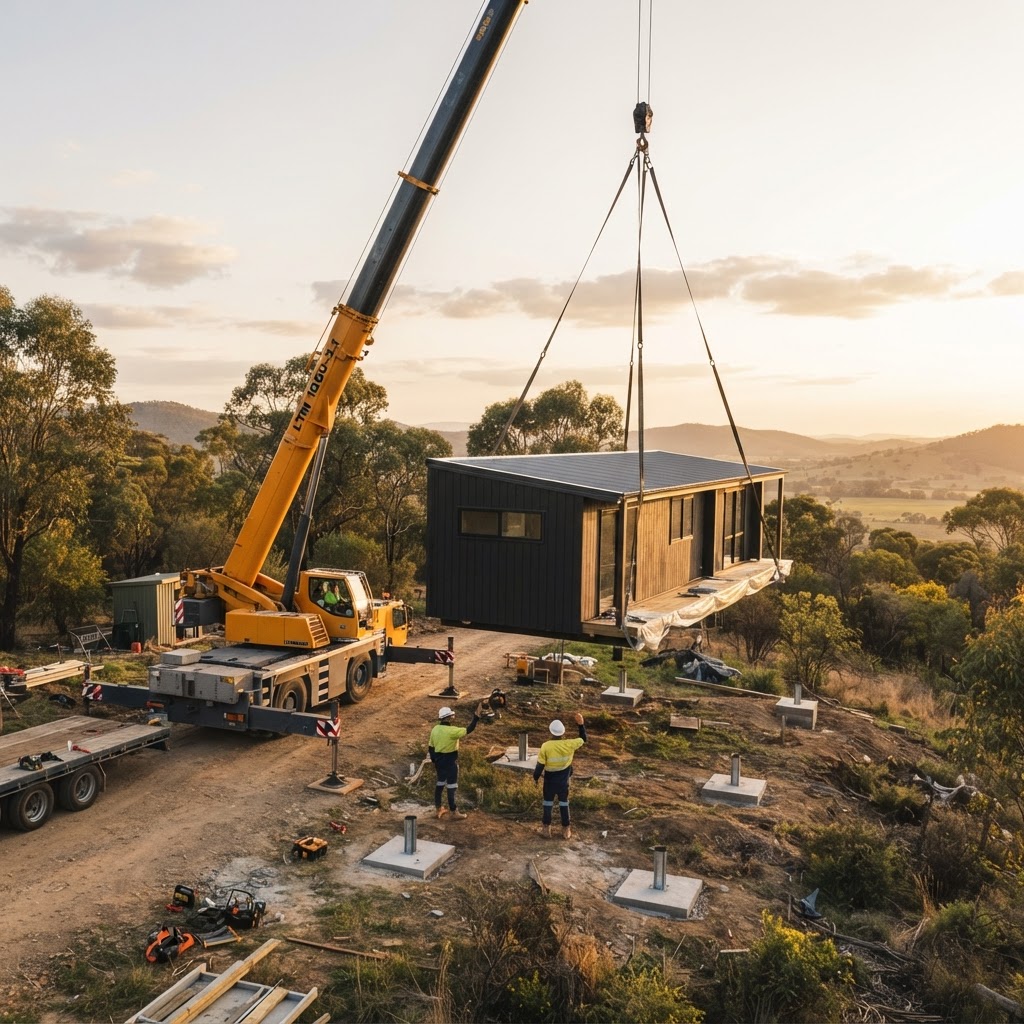
Your driveway needs to bear the truck's weight and be wide enough for it to pass. Soft, wet, or steep driveways may need temporary reinforcement or a different delivery plan. On site, there needs to be a clear, level area for the crane to set up — typically a pad roughly the size of the crane's outriggers, with enough clearance to lift the cottage over the foundation position. The crane needs firm, level ground; soft or sloping ground may require matting or a different crane position.

The crane: size, reach, setup area

Cranes come in sizes; the right crane depends on the cottage weight and the distance from the crane position to the foundation (the lift radius). A longer reach needs a larger crane, which costs more and needs more setup space. If the site doesn't allow a crane close to the foundation, a larger crane with longer reach is needed — or, on very difficult sites, the cottage may need to be delivered in a different configuration. The lift plan is usually finalised once the site and cottage dimensions are confirmed.

Overhead powerlines: a safety-critical issue

Overhead powerlines near the lift area are a serious hazard. A crane boom or a suspended load contacting a powerline can be fatal. If powerlines cross the site or the route, the power may need to be temporarily isolated (arranged with the distributor), or a different crane position chosen that keeps the lift clear of the lines. Tell your supplier about powerlines early so the lift plan accounts for them. Never assume the crane operator will 'work around' live powerlines — they won't, and they shouldn't.

What happens when access is difficult

If the standard delivery won't work, options include: a different route, a smaller cottage or a cottage delivered in sections, a larger crane with longer reach, temporary road or driveway works, or — in extreme cases — a helicopter lift (rare and very expensive). An access assessment in the feasibility phase tells you which options are viable and what they cost, before you commit to a cottage that can't reach your site. In some cases, access constraints may mean a particular cottage model isn't viable, and a smaller or sectional alternative is needed.
The Delivery & Lift Sequence

From factory to foundation — the access chain.

1Route surveyed (width, height, weight)
2Truck loaded & transported
3Driveway & site access confirmed
4Crane positioned & outriggers set
5Cottage lifted over obstacles
6Cottage placed on foundation
7Truck & crane depart

In practice

A cottage on a flatbed truck — the delivery route must be surveyed for width, height and weight limits.
A crane lifting the cottage onto foundations — the crane needs firm, level ground and clearance from powerlines.

From our experience

From our experience, access is the most overlooked part of a cottage project. Customers focus on the cottage and the approvals, and forget that a 10-tonne load has to physically reach the site and be lifted by a crane. The projects that go smoothly are the ones where someone drove the route, measured the driveway, and checked for powerlines before ordering.

We've had customers on rural blocks where the only viable delivery was via a neighbour's paddock with temporary track matting. It worked because we assessed it early. The ones who discover the problem on delivery day are the ones who didn't assess it at all.

Common Mistakes to Avoid

  1. 1

    Not doing an access assessment until after the cottage is ordered, then discovering the truck can't get there.

  2. 2

    Assuming the access that works for a car will work for a truck and crane.

  3. 3

    Not flagging overhead powerlines to the supplier — a serious safety hazard during the lift.

  4. 4

    Leaving the crane pad preparation to the last minute, so it's not ready on delivery day.

  5. 5

    Assuming a narrow driveway is fine — trucks need width and load-bearing capacity.

  6. 6

    Not accounting for wet weather softening the driveway or crane pad.

  7. 7

    Choosing a cottage size before confirming it can physically reach the site.

  8. 8

    Not clarifying in the contract who pays for access works (temporary roads, crane matting).

What changes between states?

Requirements vary by jurisdiction — always confirm with your local authority.

StateNotes
All statesOversize load permits are issued by each state's road authority. Powerline isolation is arranged with the local electricity distributor.
VictoriaVicRoads manages oversize load permits. Powerline clearance governed by the Electricity Safety Act.
QLD / NTCyclonic-season delivery may face weather restrictions — plan delivery windows accordingly.
Rural areasLocal council roads may have weight limits or seasonal restrictions (e.g., wet season in northern Australia).

When this guide doesn't apply

This guide may not apply if:

  • Your cottage is small enough to be delivered on a standard vehicle without a crane — simplified access applies.
  • Your site is a high-rise or rooftop installation — a completely different lifting and access methodology applies.
  • You're building outside Australia — local road, crane and safety regulations differ.

Frequently Asked Questions

How wide does my access need to be?

A standard cottage delivery typically needs 3–4 metres of width plus clearance. Tight corners, narrow gates, and overhanging structures can all cause problems. The transport company assesses the route, but flag obvious issues early.

What if powerlines cross my site?

Overhead powerlines near the lift area are a serious hazard. The power may need to be temporarily isolated, or a different crane position chosen. Tell your supplier about powerlines early so the lift plan accounts for them.

Can a cottage be delivered to a steep site?

Often yes, but it may need a larger crane, temporary access works, or a cottage delivered in sections. Very steep or inaccessible sites can add substantial cost. An access assessment identifies what's feasible.

Who arranges the crane and transport?

This should be specified in your contract. The cottage supplier often arranges transport and the crane, with site access provided by you. Confirm who is responsible for what, and what site preparation you need to do before delivery day.

What happens if the truck can't get to my site?

Options include a different route, a smaller or sectional cottage, a larger crane with longer reach, temporary access works, or (rarely) a helicopter lift. An access assessment early tells you what's viable and what it costs, before you commit.

Delivery Access Checklist

A checklist for assessing your delivery route, driveway, crane pad, and overhead powerlines — with the measurements to take, the questions to ask your supplier, and the warning signs that mean you need an alternative delivery plan.

This page provides general information about the pathway commonly followed in Victoria. Requirements vary by property, local government area, building classification and proposed use. Obtain site-specific advice before making financial commitments.

Reviewed by

Homes & Domes Victoria Technical Team

Last technical review

August 2026

Sources updated

August 2026

Last reviewed: July 2026 · Applicable jurisdiction: Victoria · General information only — not legal, planning or engineering advice.

Requirements vary by property, local government area, building classification and proposed use. Obtain site-specific advice before making financial commitments.